The smart ring market is moving from early adoption to broader consumer use. Two primary drivers are health monitoring and seamless digital integration. However, transitioning from concept to a reliable, mass-producible product requires solving three interconnected engineering challenges:
- Extreme miniaturization
- Unerring reliability
- Rapid innovation cycles
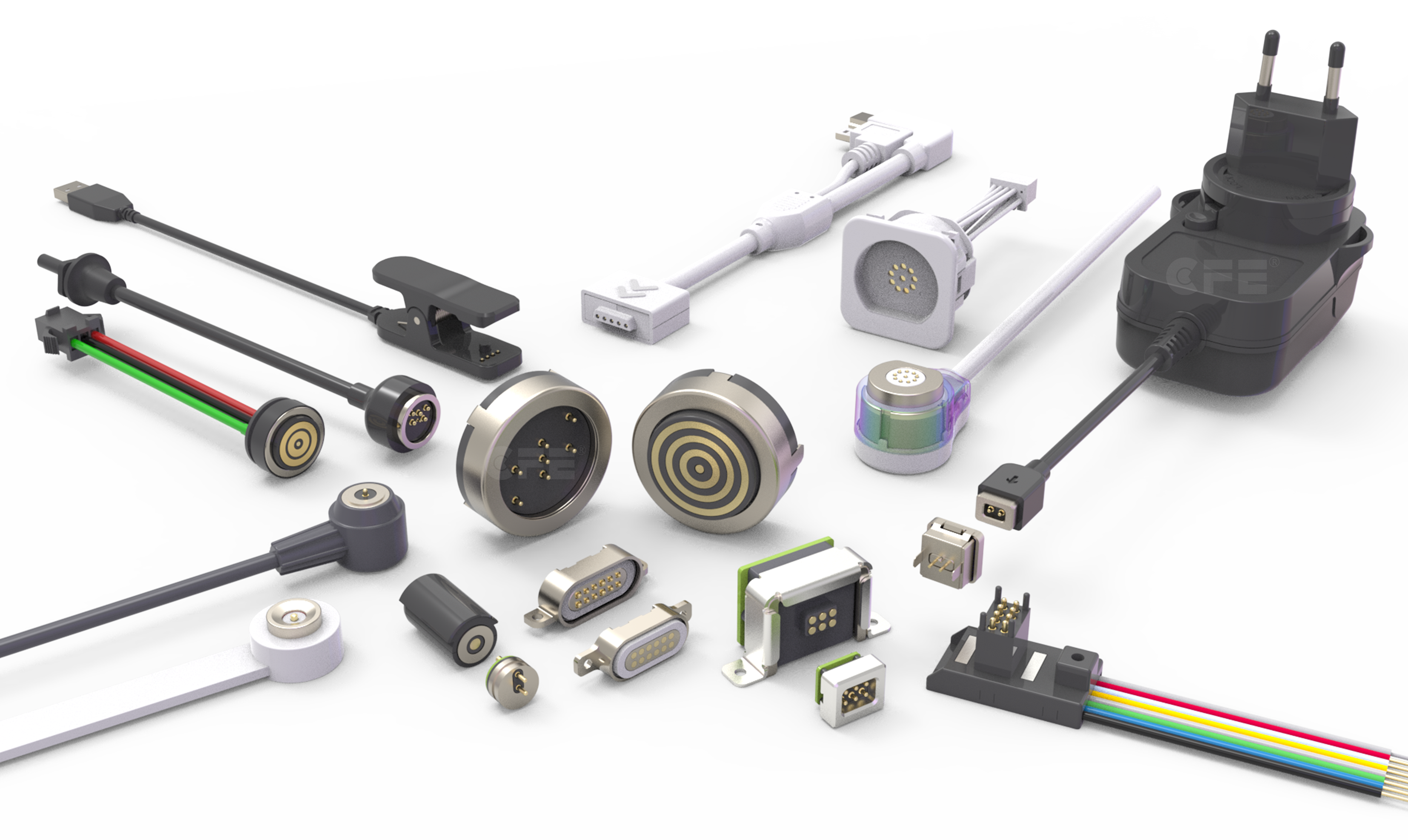
At the component level, these challenges converge on a single critical subsystem: the magnetic charging connector and associated interconnect solutions. This article reviews three connector types used in current smart ring designs and their technical trade-offs.
1. Pogo Pin Connectors: Durability in High-Cycle Applications
Smart rings typically use detachable chargers and, in some designs, modular sensor assemblies. Both require connectors that maintain electrical performance over thousands of use cycles.
The pogo pin connectors use gold-plated contacts to achieve:
- >50,000 mating cycles, validated under standard test conditions
- Low and stable contact resistance, minimizing signal loss over time
Typical application: Ring-to-charger contacts, interfaces for swappable sensor modules.
The value lies in predictable long-term electrical behavior rather than user-experience claims.

2. Magnetic Charging Connectors: Mechanical Alignment and Environmental Sealing
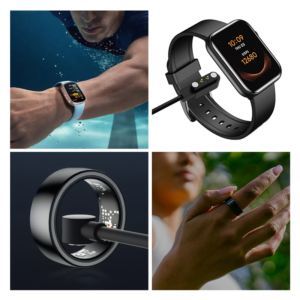
For small-form-factor wearables, connector alignment during charging is a non-trivial mechanical problem. Magnetic charging connectors solve this by providing guided, blind-mate alignment.
Additional characteristics of CLE’s magnetic connector design include:
- IP68-rated sealing when mated, protecting against sweat and incidental water exposure
- Retention force suitable for daily attachment and detachment without wear-induced failure
Typical application: Charging alignment for wireless power systems, data sync docks requiring quick connect/disconnect.
This approach reduces reliance on user precision during daily use, which is a practical reliability consideration.
3. Precision Stamped Connectors: Space-Constrained PCB Interconnects
Internal volume in a smart ring is severely limited. Every component must justify its footprint. Precision stamped connectors offer a high-density interconnect solution for miniature PCBs.
Key specifications:
- Support for high-speed data traces from PPG or ECG sensors to the main processor
- Low-profile geometry that preserves space for battery and power management components
Typical application: Connecting micro sensors to the mainboard, bridging between stacked PCBs.
The design trade-off is between contact density, current rating, and mechanical stability—all of which CFE addresses through stamped contact geometries.
From Components to System Integration
Beyond discrete connectors, CLE provides end-to-end system integration services for brands developing smart rings or similar wearables. These include:
- Industrial and mechanical design (ID/MD)
- Electronics engineering and layout
- Manufacturing and supply chain management
This is offered as an ODM/OEM service for clients seeking a complete hardware realization path.
Conclusion
Smart ring miniaturization imposes strict constraints on interconnect systems. Pogo pin connectors offer proven durability for high-cycle charging and module swapping. Magnetic charging connectors solve blind-mate alignment while providing IP68 sealing. Precision stamped connectors maximize PCB density, preserving space for batteries and sensors. The appropriate choice depends on cycle life, environmental exposure, and data bandwidth requirements.